
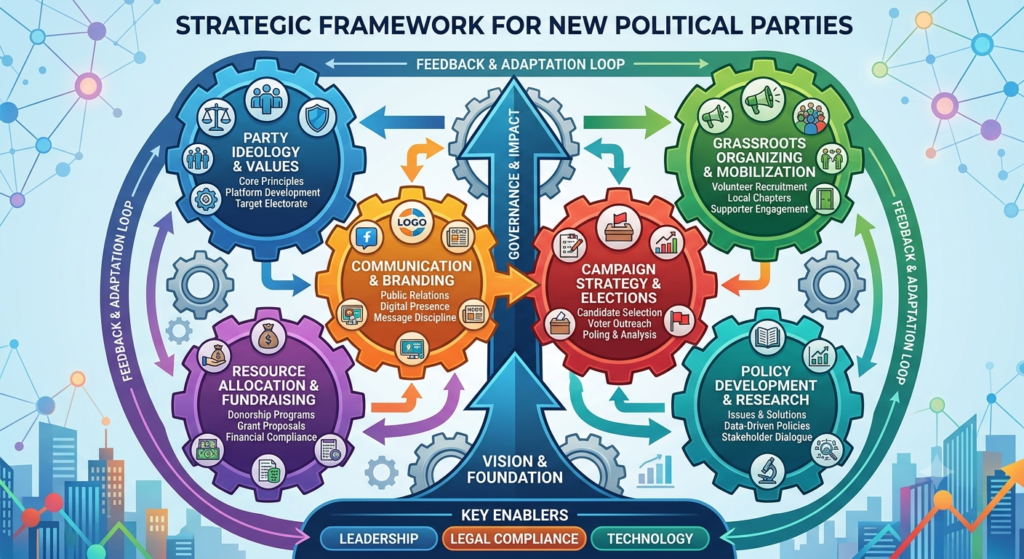
Launching a new political party is, without question, one of the most difficult undertakings in public life. Unlike an established party, a new movement has no built-in donor base, no entrenched volunteer network, and no name recognition to fall back on. As a result, founders must build everything from the ground up: identity, infrastructure, message, and momentum, often all at once. This is precisely why strategic frameworks for political parties matter so much in the earliest stages. Without a clear, structured approach, even the most passionate movement can stall before it ever reaches the ballot.
This article outlines the core frameworks that new political parties can use to move from a founding idea to a durable, electable organization. It also explains why sequencing, discipline, and data-informed decision-making matter just as much as vision and enthusiasm.
Why New Political Parties Need a Framework
Passion alone rarely sustains a new party past its first difficult season. Founders often begin with a strong sense of purpose, yet purpose without structure tends to dissolve quickly once real obstacles appear. Ballot access rules, fundraising limits, and internal disagreements can derail a movement that has no framework to fall back on.
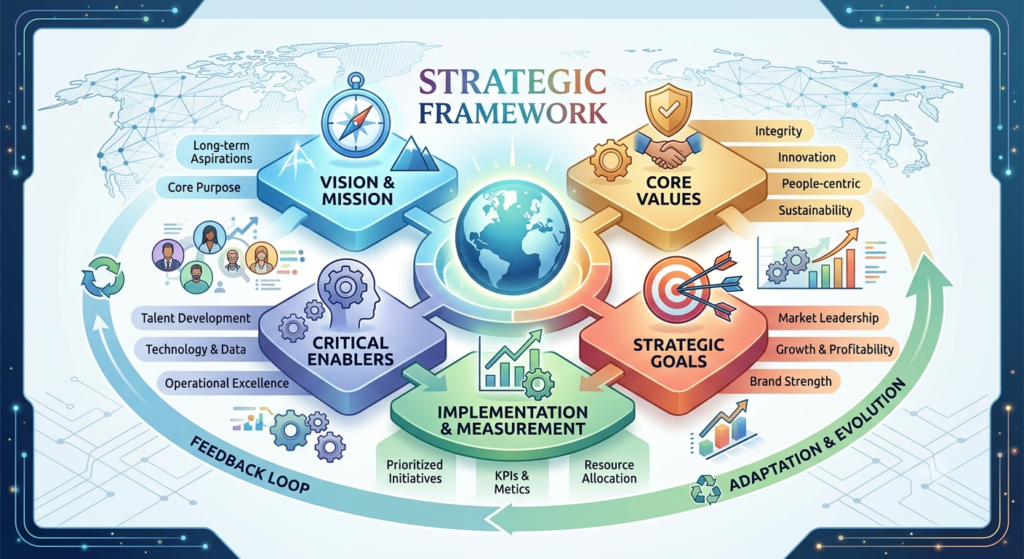
A framework, in this sense, is simply a repeatable structure for making decisions. It tells the party how to prioritize resources, how to sequence growth, and how to measure whether efforts are actually working. Furthermore, a framework provides continuity. As founders come and go, and as volunteers rotate in and out, a documented strategic framework preserves institutional memory and keeps the party moving in a consistent direction.
Core Elements of Strategic Frameworks for Political Parties
1. Founding Identity and Value Proposition
Every new party must first answer a deceptively simple question: why should this party exist? Voters are rarely drawn to parties that define themselves only in opposition to an existing one. Instead, they respond to a clear, positive value proposition — a distinct governing philosophy, a specific set of policy priorities, or a coalition of voters who feel unrepresented by the current options.
Consequently, the founding identity should be documented early and revisited often. It becomes the filter through which every later decision, from candidate recruitment to coalition-building, is evaluated.
2. Ballot Access and Legal Infrastructure
Before a new party can compete, it must exist as a legal entity capable of appearing on a ballot. This process varies significantly by jurisdiction, and it is often more resource-intensive than founders expect. Petition requirements, filing deadlines, and campaign finance registration all demand early attention.
Because these requirements are frequently the first real test of organizational capacity, treating ballot access as a strategic priority — rather than an administrative afterthought — pays dividends later. A party that stumbles here rarely recovers the credibility it needs to attract serious candidates.
3. Coalition Building
New parties succeed by assembling coalitions that existing parties have overlooked or taken for granted. This might include disaffected partisans, single-issue voters, or entire demographic groups who feel unheard. Identifying these groups requires research: voter file analysis, community listening sessions, and honest assessment of where the existing parties are vulnerable.
Once identified, coalition members must be given a meaningful stake in the party’s direction. Otherwise, coalitions built purely on opposition to the status quo tend to fracture once the initial excitement fades.
4. Candidate Recruitment and Development
A party is only as strong as the candidates who carry its banner. New parties, therefore, need a deliberate recruitment strategy rather than relying on volunteers who simply step forward. Strong candidates should be identified early, trained in messaging and fundraising, and supported with the operational infrastructure that established parties often provide but new parties must build themselves.
In turn, investing in candidate development compounds over time. Early candidates, even if unsuccessful, become the trained bench of leadership that future cycles depend on.
5. Messaging and Narrative Discipline
New political parties frequently struggle with message discipline, in part because founders are often passionate about multiple issues simultaneously. However, voters absorb simple, repeated narratives far more readily than sprawling policy platforms. A disciplined messaging framework identifies two or three core themes and insists that every communication, from social media posts to candidate speeches, reinforces them.
This discipline does not mean abandoning nuance. Rather, it means channeling nuance into a consistent narrative structure that voters can recognize and repeat back.
6. Data Infrastructure from Day One
Even at the earliest stages, new parties benefit enormously from building data infrastructure alongside their organizing efforts. Voter contact information, volunteer records, and donor data should be captured systematically rather than scattered across spreadsheets and personal contacts. As the party grows, this data becomes the foundation for targeted outreach, fundraising, and eventually, full-scale campaign operations.
Parties that delay this investment often find themselves rebuilding basic infrastructure mid-campaign, precisely when time is most scarce.
Sequencing: What Comes First
One of the most common mistakes among new political parties is attempting to do everything at once. Strategic frameworks for political parties typically recommend a phased sequence instead.
First, establish legal existence and ballot access. Second, define the founding identity and core message. Third, build initial coalitions and recruit a small number of strong candidates. Fourth, invest in data and fundraising infrastructure. Finally, scale outward through expanded candidate recruitment and broader coalition growth.
This sequence is not rigid, and circumstances will inevitably require adjustments. Nevertheless, having a default sequence prevents founders from spreading limited resources too thin across too many priorities simultaneously.
Measuring Progress
Strategic frameworks are only useful if progress can be measured against them. New parties should track concrete indicators: number of ballot lines secured, volunteer growth rate, fundraising totals relative to goals, and voter contact numbers. These metrics should be reviewed on a regular cadence, allowing leadership to adjust strategy before small problems become existential ones.
Moreover, transparency around these metrics helps maintain trust among volunteers and donors, who are often taking a considerable leap of faith in supporting an unproven organization.
Common Pitfalls to Avoid
Several patterns tend to derail new parties regardless of their founding enthusiasm. Overextending into too many races before building organizational capacity is one common error. Neglecting legal compliance in favor of visible organizing activity is another. Perhaps most damaging is allowing internal ideological disputes to consume energy that should be directed toward external growth.
Recognizing these pitfalls early, and building safeguards against them into the founding framework, significantly improves a new party’s odds of long-term survival.
Conclusion
Building a new political party is an ambitious, resource-intensive undertaking, and enthusiasm alone will not carry it across the finish line. Instead, durable strategic frameworks for political parties — covering identity, legal infrastructure, coalition-building, candidate development, messaging discipline, and data capacity — give founders a structured path forward. When these elements are sequenced deliberately and measured consistently, a new party moves from an idea shared among a small group of believers to a credible, electable organization capable of shaping the political landscape for years to come.
For any founding team ready to move beyond enthusiasm and into execution, the essential first step is simple: commit the framework to paper, and then hold the organization accountable to it.
Want expert guidance on applying these frameworks? Contact LEADGOVTOS and let’s design your party’s path to success.