

Elections are no longer won on charisma and gut instinct alone. Today, the most successful campaigns are built on data intelligence for elections — information that is carefully collected, rigorously analyzed, and then strategically applied at every stage of the electoral journey. After all, campaign budgets are finite, voter attention is scarce, and margins of victory are often razor-thin. As a result, data intelligence has become the deciding factor between a candidate who wins and one who falls short.
This shift is not a passing trend. Rather, it represents a fundamental change in how political campaigns are conceived, executed, and measured. For candidates and their teams, understanding how to harness data intelligence is therefore no longer optional. It is the price of admission for running a competitive campaign in the modern era.
What Is Data Intelligence in a Political Context?

In practice, data intelligence combines several disciplines: statistical analysis, predictive modeling, geographic information systems (GIS), and behavioral science. Increasingly, it also draws on artificial intelligence. Together, these tools allow campaigns to move from broad, one-size-fits-all messaging toward precision targeting that speaks directly to the concerns of individual voter segments.
Why Data Intelligence for Elections Matters More Than Ever
Three forces have converged to make data intelligence indispensable to modern campaigns.
First, the electorate has fragmented. Voters no longer fit neatly into simple party lines. For instance, issues like the economy, healthcare, education, and local infrastructure resonate differently across age groups, income brackets, and geographic regions. Consequently, a message that energizes one segment may alienate another. Data intelligence, however, allows campaigns to understand this fragmentation and respond to it with nuance rather than guesswork.
Second, resources are limited. Every campaign operates under constraints of time, money, and volunteer capacity. Because of this, data intelligence ensures these scarce resources are deployed where they will have the greatest impact. Instead of wasting effort on voters who are already committed or entirely unreachable, campaigns can focus squarely on those who are persuadable.
Third, the information environment has become more complex. Voters now consume information across a sprawling mix of television, social media, text messages, and community networks, not to mention simple word of mouth. Understanding which channels influence which voters, and when, therefore requires sophisticated data analysis that goes far beyond traditional polling.
Key Applications of Data Intelligence in Campaigns

1. Voter Segmentation and Microtargeting
Perhaps the most powerful application of data intelligence is voter segmentation. This means dividing the electorate into distinct groups based on shared characteristics, behaviors, and concerns. Rather than treating all voters as a single audience, campaigns can identify segments such as “persuadable independents concerned about local jobs” or “first-time voters motivated by climate policy.”
Once these segments are defined, microtargeting becomes possible. Campaigns can craft tailored messages for each group and then deliver them through the channels those voters are most likely to engage with. As a result, this precision dramatically increases the efficiency of both advertising spend and volunteer outreach.
2. Predictive Modeling
Predictive models use historical voting data, demographic trends, and behavioral indicators to forecast turnout likelihood and candidate support at the individual voter level. In turn, these models help campaigns answer critical questions. Who is likely to vote but remains undecided? Who is a strong supporter that simply needs a turnout push rather than persuasion? And who is unlikely to vote at all, regardless of outreach?
By scoring every voter on the file with a probability of support and a probability of turnout, campaigns can prioritize outreach with a level of efficiency that was simply impossible a generation ago.
3. Sentiment Analysis and Real-Time Feedback
Social media and digital engagement generate an enormous volume of real-time feedback on how a candidate’s messaging is landing. Sentiment analysis tools can process this data at scale. Specifically, they flag emerging concerns, track how policy announcements are received, and identify which narratives are gaining traction, often before traditional polling would catch them.
Because of this speed, campaigns can remain agile. Rather than waiting weeks for the next poll, teams can adjust messaging and rapid-response strategy in near real time.
4. Geographic and Field Optimization
Data intelligence also transforms field operations. By mapping voter data geographically, campaigns can optimize canvassing routes, identify high-value neighborhoods for door-knocking, and allocate volunteer time to areas with the greatest potential return. In this way, field organizing shifts from an intuition-driven exercise into a genuinely data-informed operation.
5. Fundraising Intelligence
Similarly, data-driven donor analysis identifies which supporters are most likely to give, how much they are likely to contribute, and which fundraising appeals resonate with them. Consequently, campaigns can build smarter fundraising calendars while personalizing outreach to major donors and grassroots contributors alike.
6. Get-Out-The-Vote (GOTV) Precision
In the final stretch of a campaign, data intelligence becomes essential for GOTV efforts. By identifying supporters who are enthusiastic yet historically inconsistent voters, campaigns can focus reminder calls, texts, and rides to the polls precisely where they will make the difference. Ultimately, this turns latent support into counted votes.
Building a Data-Driven Campaign Strategy
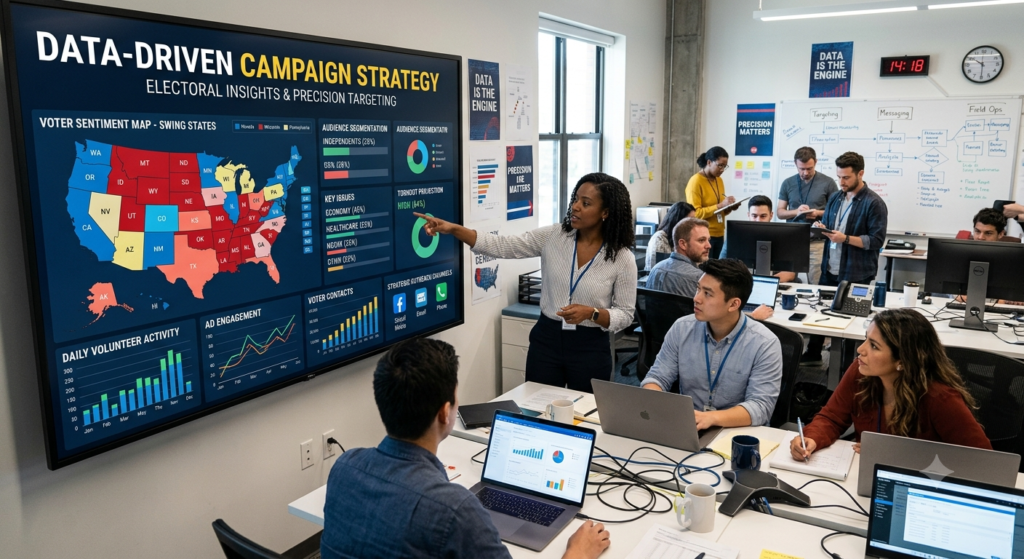
For candidates and campaign teams looking to harness data intelligence for elections effectively, a few principles are essential.
First, start with clean, integrated data. Fragmented or outdated voter files undermine every downstream analysis, so investing in data hygiene early pays dividends throughout the campaign.
Second, combine quantitative and qualitative insight. Data should inform strategy, but it works best alongside on-the-ground knowledge from field organizers and community leaders who understand local context.
Third, iterate continuously. Data intelligence is not a one-time setup. Instead, it requires ongoing refinement as new information comes in from canvassing, polling, and digital engagement.
Finally, protect voter privacy and data security. Trust is a campaign’s most valuable asset, and responsible data practices are therefore not just an ethical obligation but a strategic necessity.
The Competitive Edge
Campaigns that embrace data intelligence gain a structural advantage. They spend smarter, message more precisely, and adapt faster than opponents who rely on instinct alone. In closely contested races, where victory margins can come down to a few thousand votes, or even a few hundred, this edge can ultimately prove decisive.
For political consultancies and campaign support teams, the ability to deliver sophisticated data intelligence services has therefore become a core differentiator. Increasingly, candidates are seeking partners who can not only run a campaign but also build and interpret the data infrastructure that powers modern electoral success.
Conclusion
The path to election victory in today’s political landscape runs through data intelligence for elections. From voter segmentation and predictive modeling to real-time sentiment tracking and precision GOTV efforts, this approach equips campaigns with the clarity and efficiency needed to compete, and ultimately win, in an increasingly complex electoral environment. Candidates who invest in robust data intelligence capabilities, along with the teams who support them, position themselves not just to run a smoother campaign, but also to convert that smoothness into measurable results on election day.
For campaigns ready to move beyond guesswork and into a data-driven future, the question is no longer whether to invest in data intelligence for elections. It is, instead, how quickly they can build the capability to use it well.
Winning campaigns don’t happen by accident — they happen by design. LEADGOVTOS helps candidates build the voter data infrastructure, predictive models, and targeting strategy needed to compete and win. Contact us today to see how a data-driven approach can transform your next campaign.
Well written. As technology continues to reshape politics, campaigns that combine strong leadership with data intelligence will likely have a significant edge. Looking forward to seeing how this evolves.