
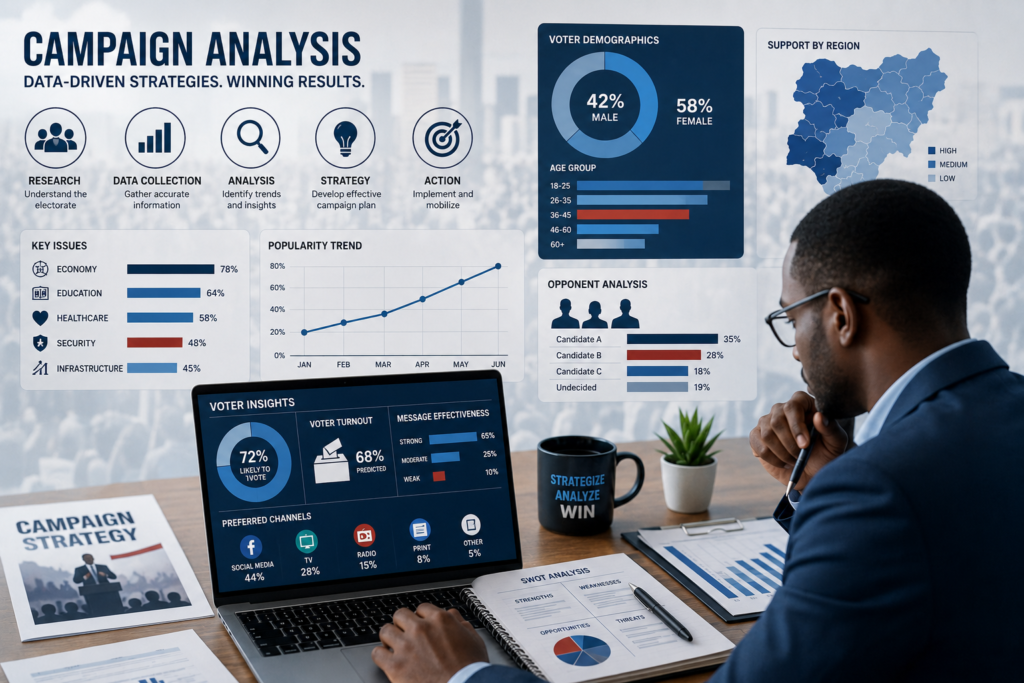
In the high-stakes arena of Nigerian and African politics, winning elections demands more than charisma, rallies, or deep pockets. It requires systematic intelligence. Opposition analysis techniques — the structured process of gathering, analyzing, and leveraging actionable insights about political rivals — have become indispensable for campaigns seeking sustainable victory.
At LEADGovtOS, we champion the shift from personality-driven, reactive campaigns to data-informed infrastructures that deliver both electoral success and effective governance. This cornerstone guide explores proven opposition analysis techniques tailored to the African context, with a focus on Nigeria’s complex political landscape ahead of the 2027 general elections and beyond.
Whether you are a candidate, campaign strategist, or political operative, mastering these methods will help you replace guesswork with precision, turning potential vulnerabilities into strategic advantages.
Why Opposition Analysis Is Critical in African Democratic Politics
African elections, particularly in Nigeria, are characterized by incumbency advantages, ethnic and regional dynamics, coalition fragility, and intense resource competition. Opposition parties and candidates often face fragmented landscapes, as seen in the lead-up to 2027, where internal divisions within major opposition platforms have raised questions about their ability to mount unified challenges.
Effective opposition analysis addresses these realities by:
- Identifying inconsistencies in rivals’ records, messaging, and performance.
- Enabling precise voter targeting and contrast messaging.
- Informing resource allocation for maximum impact.
- Supporting post-election governance planning by anticipating challenges.
Traditional “oppo research” has evolved. No longer limited to scandal-hunting, modern techniques integrate strategic intelligence, voter demographics modeling, and real-time data analytics — exactly the capabilities embedded in platforms like LEADGovtOS™.
Historical examples underscore this. The 2015 Nigerian election demonstrated how opposition coordination, narrative control, and amplification of incumbent weaknesses could overcome structural disadvantages. In contrast, fragmented or poorly researched campaigns in subsequent cycles have struggled to convert public discontent into votes.
By 2035, LEADGovtOS envisions dozens of professionalized campaigns across Nigeria and emerging markets leveraging these systems. Opposition analysis is not a “dark art” but a pillar of institutional transformation in African democracy.
Core Opposition Analysis Techniques for Modern Campaigns
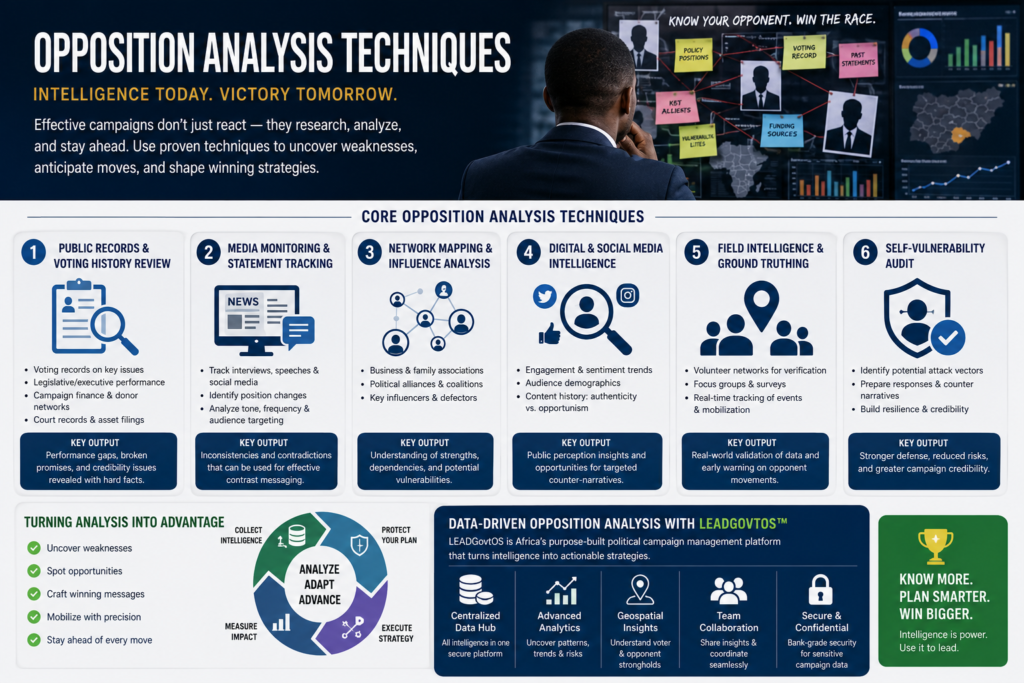
1. Comprehensive Public Records and Voting History Review
Start with verifiable data. For incumbents or experienced politicians, scrutinize:
- Voting records on key issues (economy, security, education, infrastructure).
- Legislative or executive performance audits.
- Campaign finance disclosures and donor networks.
- Court records, property filings, and regulatory documents.
Practical Steps:
- Use INEC resources, state assemblies’ archives, and public databases.
- Build timelines comparing promises versus delivery.
- Quantify patterns, such as attendance rates or budget utilization.
This technique reveals policy flip-flops or performance gaps that form the foundation of credible contrast messaging.
2. Media Monitoring and Statement Tracking
Public statements often contain the richest veins of intelligence. Track:
- Interviews, speeches, and social media activity over multiple election cycles.
- Changes in positioning on critical national issues.
- Tone, frequency, and audience targeting.
Advanced campaigns deploy media monitoring tools to flag inconsistencies. For instance, a candidate promising fiscal discipline while associated with high-cost projects creates exploitable contrasts — when framed around measurable governance outcomes.
3. Network Mapping and Influence Analysis
No candidate operates in isolation. Map:
- Business associations and family ties (where publicly relevant).
- Political alliances and past coalition partners.
- Key influencers and potential defectors.
This reveals strengths (e.g., strong regional bases) and weaknesses (e.g., over-reliance on controversial figures). In Nigeria’s multi-ethnic context, understanding how rivals navigate regional sentiments is vital.
4. Digital and Social Media Intelligence
Social platforms amplify both opportunities and risks. Analyze:
- Engagement patterns and sentiment trends.
- Audience demographics.
- Historical content for authenticity vs. opportunism.
With youth and urban voters playing larger roles (as evidenced in recent cycles), digital opposition analysis helps craft targeted counter-narratives.
5. Field Intelligence and Ground Truthing
Data must meet reality. Deploy:
- Volunteer networks for on-ground verification.
- Focus groups and surveys in key constituencies.
- Real-time tracking of rival events and mobilization efforts.
LEADGovtOS’s campaign systems excel here, offering field operation tracking and volunteer CRM tools that turn raw observations into structured intelligence.
6. Self-Vulnerability Audit (Defensive Opposition Analysis)
Smart campaigns research themselves first. Identify potential attack vectors in your own record and prepare responses. This proactive step builds resilience and credibility.
Data-Driven Opposition Analysis: The LEADGovtOS Advantage
Traditional methods alone are insufficient in today’s environment. LEADGovtOS™ — Africa’s purpose-built political campaign management platform — integrates these techniques into a centralized, secure environment.
Key Capabilities:
- Voter Demographics Modeling: Layer public data with proprietary insights for precise targeting.
- Message Efficacy Testing: Simulate how opposition narratives resonate across segments.
- Real-Time Analytics Dashboards: Monitor rival activities and public sentiment dynamically.
- LEAD Governance Index™ Integration: Benchmark performance against objective governance metrics.
This systems approach replaces reactive firefighting with proactive strategy. Campaigns can model hundreds of scenarios, optimize resource allocation, and maintain 100% confidentiality standards.
For governance-focused entities, post-election opposition analysis transitions seamlessly into performance frameworks and policy implementation audits.
Case Studies: Opposition Analysis in Action
2015 Nigerian General Elections: The opposition successfully amplified incumbent challenges around security and economy through coordinated intelligence. They did not rely solely on charisma but built a narrative grounded in observable failures, supported by coalition-building and narrative dominance.
Recent Cycles and 2023 Insights: The emergence of youth-driven movements highlighted the power of digital intelligence and authentic messaging. Campaigns that effectively analyzed shifting voter priorities — particularly among urban and younger demographics — achieved outsized impact despite structural disadvantages.
African Parallels: Across the continent, parties leveraging systematic research have professionalized their approach, moving beyond personality cults toward measurable accountability.
These examples illustrate a consistent truth: campaigns that invest in opposition analysis early gain compounding advantages throughout the electoral cycle.
Best Practices and Ethical Considerations
- Prioritize Ethics and Legality: Focus on public records and verifiable facts. Avoid misinformation or privacy violations, which can backfire dramatically.
- Integrate with Broader Strategy: Opposition insights should inform messaging, resource deployment, and debate preparation — not exist in isolation.
- Maintain Organization: Use centralized platforms to log findings, sources, and actionability.
- Focus on Voter-Relevant Contrasts: Emphasize policy differences and governance records over personal attacks.
- Continuous Monitoring: Analysis is not a one-time exercise. Update intelligence regularly, especially in fluid environments like Nigeria’s pre-2027 landscape.
- Combine with Positive Vision: The strongest campaigns use opposition analysis to sharpen their own offerings, demonstrating superior solutions.
LEADGovtOS adheres to a strict ethical framework, ensuring all intelligence supports accountable, results-driven politics.
Implementation Roadmap for Your Campaign
Phase 1: Foundation (6–12 Months Out) Conduct baseline research on primary rivals and self-audit.
Phase 2: Deep Dive (3–6 Months Out) Layer quantitative data with field intelligence. Test messages.
Phase 3: Execution (Campaign Period) Deploy real-time monitoring and adaptive strategies.
Phase 4: Post-Election Transition insights into governance performance architectures.
Campaigns using this roadmap report higher efficiency in volunteer management, donor engagement, and voter outreach.
Common Pitfalls to Avoid
- Over-reliance on unverified social media rumors.
- Neglecting regional and local nuances in a diverse federation like Nigeria.
- Failing to integrate analysis with field operations.
- Reactive rather than proactive approaches.
Data-driven discipline mitigates these risks.
The Future of Opposition Analysis in Africa
By 2035, the most successful campaigns and administrations will be those that institutionalize intelligence. LEADGovtOS is building the operational standard — the NGP VAN equivalent for African politics — combining strategic consulting, robust technology, and governance advisory.
Opposition analysis is central to this transformation. It professionalizes politics, strengthens democratic accountability, and ultimately delivers better governance outcomes for citizens.
Conclusion: Build the System That Delivers Victory
Mastering opposition analysis techniques is no longer optional for serious contenders in Nigerian and African elections. It is the foundation of data-informed campaigns that win — and govern effectively.
At LEADGovtOS, we provide the full architecture: from intelligence gathering to campaign execution systems and post-election governance frameworks.
Ready to transform your approach?
- Request a Political Strategy & Intelligence consultation.
- Book a LEADGovtOS™ Platform Demo.
- Explore partnership opportunities for implementation.
Contact us at leadgovtos.org or +234 707 609 2561.
The future of African democracy belongs to campaigns and administrations that build systems, not merely personalities. Start building yours today.